

How VoIP Can Boost Customer Retention and Drive Business Growth


Businesses are slowly switching to Voice over Internet Protocol (VoIP), and why is it? As compared to a traditional phone system, it is changing how you interact with your customers. It has changed the way we interact, as it combines multiple channels and offers a smooth conversation.
VoIP helps businesses ensure timely follow-ups and helps them understand their customers better. With its wide range of features, you can keep customers loyal and engaged while supporting growth. The ways VoIP impacts retention and expansion are subtle, yet powerful.
In this blog, you will learn how VoIP goes beyond making calls. From improving customer experience to driving growth, there’s a lot to uncover. You’ll be able to implement processes to better your customer retention and growth, as well as other details. Let’s explore right away.
To create a successful business, you need to focus on customer retention foremost. It will be costly to acquire a new customer rather than keep an existing one. The way you treat your customers will affect their satisfaction levels and chances of them coming back.
If anyone is using a system, then they always expect fast and smooth communication, often across multiple channels. It is phone calls that remain a critical touchpoint, whether it is a support or sales call. How good, fast, and relevant such exchanges are can make or break your deal.
Many customers leave, feeling unheard or unattended, or dissatisfied with the time it takes to respond. An example is where the customer calls a company and is held on hold for an extended period, or they are repeatedly switched to the wrong department. They get more agitated and may end up going elsewhere.
By this point, you may have gotten the idea that communication is directly related to customer retention. Better communication means better retention, and VoIP makes it possible to achieve it. It offers flexibility, integration, and cost savings that directly improve communication quality.
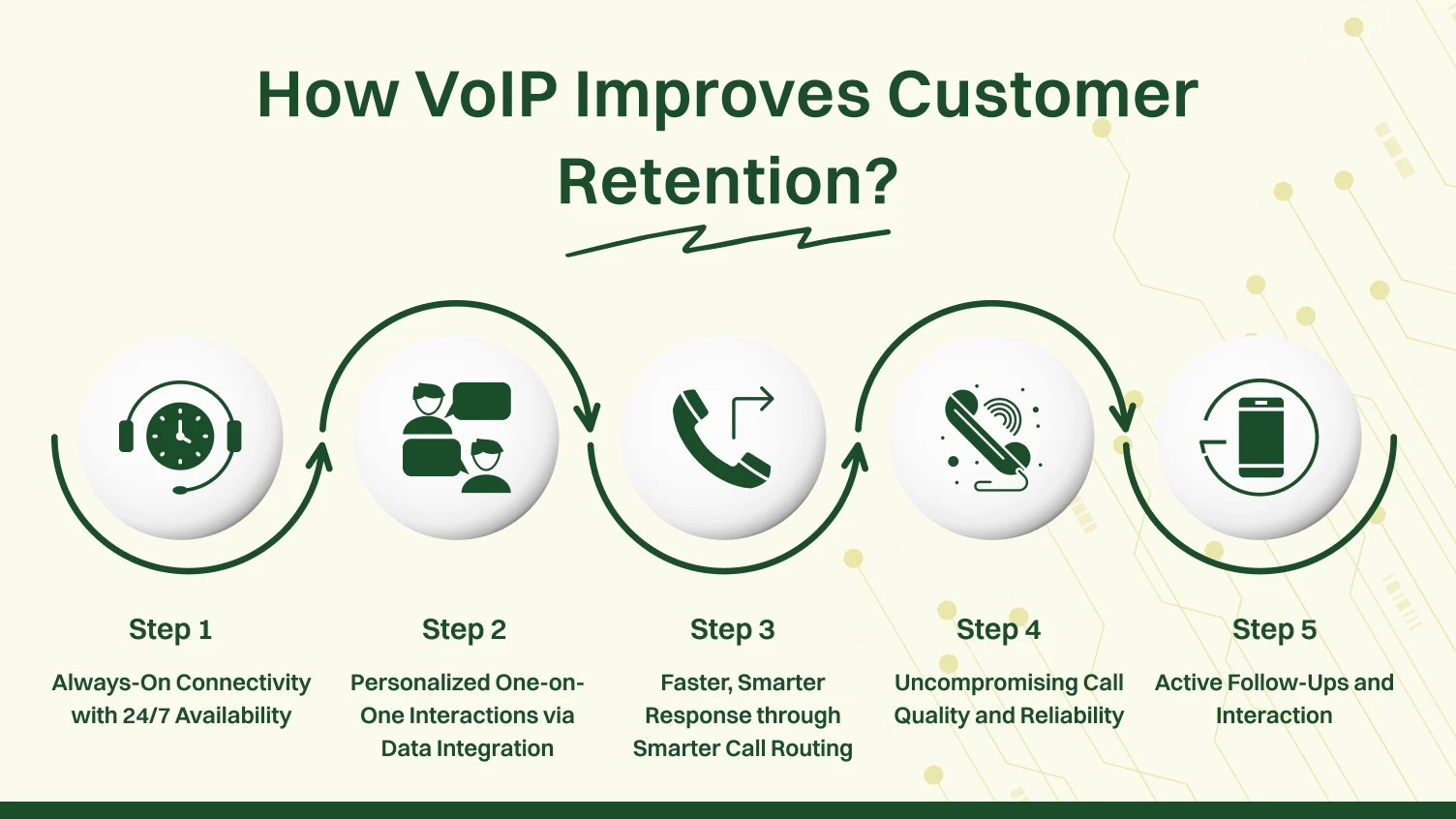
Keeping customers isn’t just luck. It comes from good, steady communication. Every call and follow-up shapes how they see your business. VoIP gives you the tools to make these moments faster, more personal, and more reliable. Let’s see how it helps turn everyday calls into reasons for customers to stay.
Failure to deliver service during a time of need is one of the key sources of losing clients. VoIP tackles it head-on through its features, such as:
All these skills will give customers confidence that their problems will be taken care of, and this is what provides loyalty.
VoIP may be integrated into CRM software to display to agents, in real time, caller history, preferences, and purchase history. This allows teams to have abilities like:
This level of personalization makes callers feel special, raises satisfaction, and encourages repeat business.
Long holds and constant reroutes are not pleasant. VoIP utilizes automated call distribution with each caller directed to the right agent based on skills, availability, or priority. This reduces hold time and increases first-call resolution of problems to the fullest extent. Also, the customer has a good customer experience as their concerns and issues are addressed quickly.
Static, lost calls, and lag instantly can harm a company’s image in front of clients. VoIP implements Quality of Service (QoS) as well, which provides high preference to mandatory voice traffic. Also, it provides stable and precise links even within overloaded networks. High-quality voice connections establish a professional and credible brand image.
Customer retention is a long-term process following an original call. VoIP provides an avenue for follow-ups through pre-scheduled callbacks, reminders, and advertising messages. This ability will not hinder clients’ personal time, which helps maintain the relationship.
Introduction of Voice over Internet Protocol (VoIP) technologies can sustainably outline tremendous business growth. It harmoniously integrates cost-effectiveness, scalability, and improved collaboration. That is the whole meaning of VoIP, bringing about sustainable development for organizations:
| Growth Factor | VoIP Advantage | Business Impact |
|---|---|---|
| Cost savings | Uses the internet instead of costly phone lines | More funds for expansion |
| Scalability | Add lines without new hardware | Supports company growth easily |
| Collaboration | Video calls, messaging, and call recording | Faster decision-making |
| Disaster recovery | Cloud backup and redundancy | Less downtime during crises |
VoIP lowers costs of operation by utilizing the internet infrastructure to reduce the use of special dedicated phone lines and costly hardware installations. Companies, in addition, have reduced expenditure and reduced hardware investment, with savings on the budget for future expansion investment.
Telephony systems are easily expanded by the company as the company grows by adding additional extensions or lines without any physical plant changes. The employee will have the privilege of working from anywhere, using VoIP, as the internet is only needed to make it happen.
VoIP products have added functions beyond the buying of standard phone calls. It has a wide array of features to improve communications, customer communications, and productivity.
VOIP is usually cloud-hosted or cloud-based with back-ups. This means even in a physical disaster or issues like a power outage, you can achieve an uninterrupted workflow. It will restrict downtime and enable business continuity under unfavorable conditions with such fault tolerance.
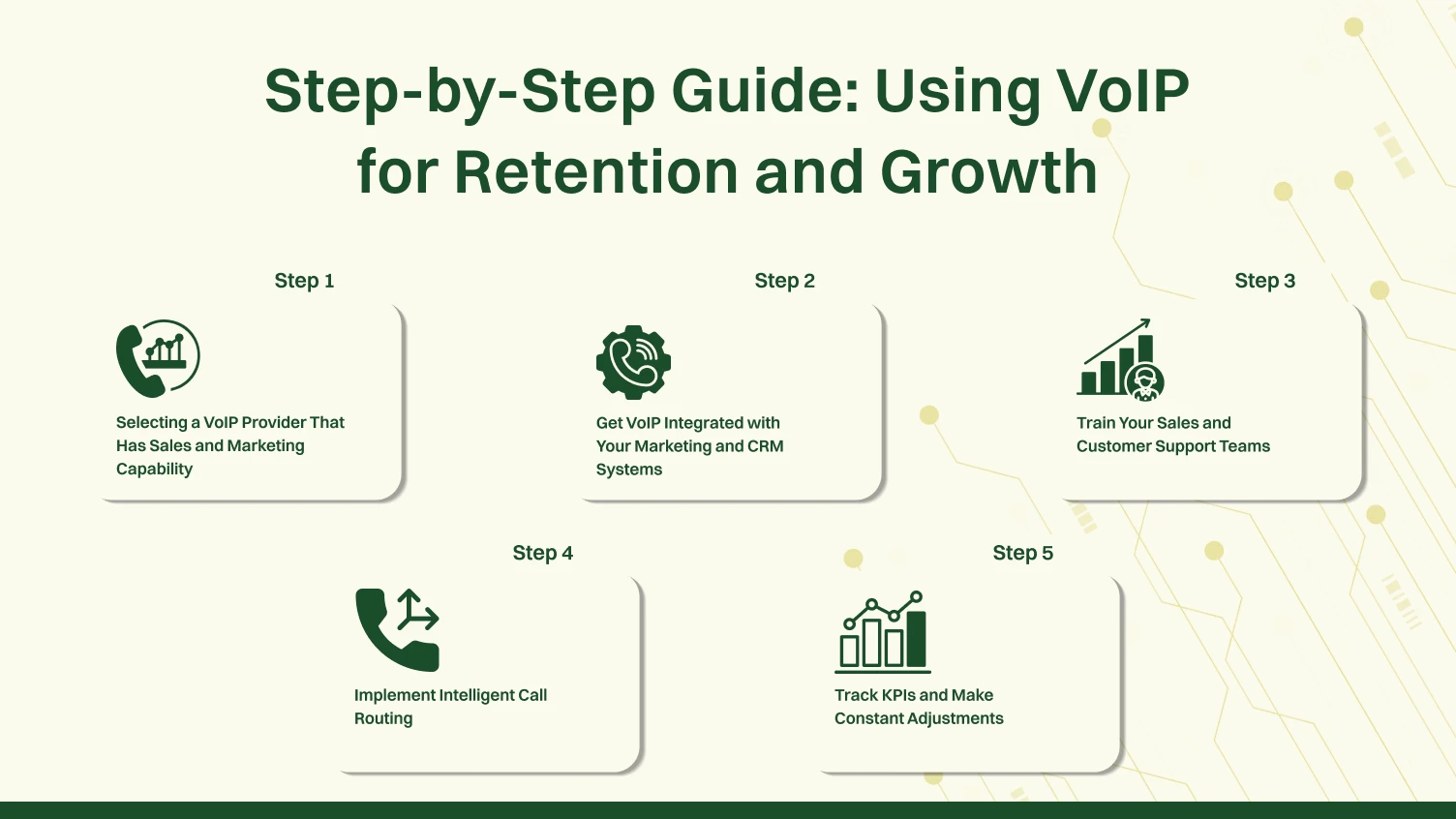
Your customer dealings and business performance depend on how you adopt and use VoIP. Features available with VoIP include call routing and CRM integration, as well as analytics. It assists companies to increase response speed, individualize service, and help retain customers. Here are the steps to follow.
All VoIP systems are not created equal. You should choose a VoIP provider that has features suited for marketing and sales, which impact client retention. A good phone system is always a basis for improved customer interaction, quick response, and better customer relations.
Always try to integrate your VoIP with CRM and marketing applications. By doing so, it allows agents to access callers’ information at their fingertips. They will be able to track interactions, campaign results, call history, and more.
Your team should be well-trained to use VoIP features. The staff must know how to handle calls. They are expected to study how to utilize CRM data to personalize conversations and automate follow-ups. Properly trained employees are also more confident and able to give a consistent service.
You can direct each caller to the correct department or agent and reduce wait times with the call routing feature. Moreover, offer round-the-clock, faultless support with added abilities like after-hours routing and voicemail-to-email notifications. When customers get the proper support, they are less frustrated.
You can easily improve customer retention by simply tracking the key performance indicators (KPIs). Your first-call measures, abandonment, and call wait time determine the success of the team and the system in use. Use the metrics to refine the flows, train more, and optimize the call routing for consistent growth.
VoIP can do more than just handle calls. Many businesses fail to get the full benefits because of common errors. Misusing VoIP, neglecting training, or ignoring data can hurt customer retention and growth. Understanding these mistakes helps your team use VoIP strategically and avoid lost opportunities.
Some companies buy VoIP only to save money, missing its real potential. You shouldn’t think of it for making cheaper phone calls, because it offers more than that, such as for sales, marketing, and customer engagement. It’s a pity if you use it only for making calls.
Without proper training, employees may not use VoIP tools effectively. This limits personalization, slows responses, and reduces customer satisfaction. Your team needs a specific guide on call handling, CRM integrations, and automated follow-ups. Well-trained staff give consistent performance with low effort.
When using a VoIP, you always need to check if it is delivering consistent call quality. Poor call quality can annoy customers and may also damage the brand’s image. Analytics is most used in VoIP, and ignoring it means missing patterns that indicate areas of improvement.
Using a VoIP boosts your business with features to improve interaction and help your business grow. If the interactions are top-notch, then it will automatically create customer retention. Here is the table that shows how each feature plays a role in retention and growth. Also, explore in detail each feature.
| VoIP Feature | How It Helps Keep Customers | How It Helps Business Growth |
|---|---|---|
| Call Forwarding | Makes sure calls go to the right person, so customers never feel ignored. | Reduces missed opportunities and keeps sales moving. |
| Auto Attendant | Greets callers quickly and sends them to the correct department. | Saves staff time and improves efficiency. |
| Voicemail to Email | Lets you respond faster by sending voicemails to your email. | Speeds up communication and prevents lost leads. |
| CRM Integration | Gives staff customer history during calls for better service. | Builds stronger relationships and increases repeat sales. |
| Call Analytics | Shows call patterns so you can fix issues fast. | Helps improve processes and boost productivity. |
| HD Voice Quality | Makes conversations clear, avoiding misunderstandings. | Enhances trust and makes your brand sound professional. |
| Call Recording | Lets you review calls for training and service improvement. | Helps maintain quality and supports staff training. |
Call forwarding is a feature that sends incoming calls to another number. It always ensures the calls are not dropped and customers always reach your agents. Using it will effectively help to lower missed calls and improve response speed. This feature is best for businesses with remote staff or multiple offices.
Customers are guided to the correct department or person with the auto attendant without needing a staff member. It creates a professional first impression and saves time for both agents and clients. This ability ensures callers don’t get lost in long menus or repeated transfers.
Voicemail-to-email service literally puts recorded messages in your email inbox. Agent can divert and attend to their customers, either when they are off the desk. This prevents the loss of any significant customer inquiry, and it also helps in retaining quick and assured services.
The VoIP system is connected to customer relationship management software with CRM integration. It allows agents to view the history, purchasing, and previous interaction with the customer immediately. This will make discussions more personal, faster in solving problems, and improve customer relations.
Call analytics measures such variables as the volume of calls, their length, and results. Businesses are able to detect trends, benchmark the performance of the agents involved, and establish areas that need improvement. Analytics will assist in making data-related decisions that raise customer satisfaction and operational performance.
HD voice quality ensures calls are clear and natural. Better sound reduces misunderstandings and improves customer confidence. Clear communication enhances professionalism, especially during technical discussions or sensitive customer conversations.
Call recording stores talks for quality control and training, and also resolves disputes. The recorded calls can help managers identify areas where help is lacking and can be used to train the staff. It also serves to cover customers and the business by maintaining a record of interactions.
VoIP is more than just a way to make calls. It is a complete communication system that builds strong customer relationships and supports business growth. With features that boost speed, personalization, and efficiency, it keeps customers happy and loyal.
When added to daily operations, VoIP can cut costs, scale with your needs, and keep service consistent. From call forwarding to call analytics, each feature plays a role in retention and profits. In today’s market, VoIP is not just useful—it is essential.
Upgrade to Dialaxy today and power your business growth with smarter communication!
VoIP (Voice over Internet Protocol) lets you make calls using the internet instead of phone lines. It turns your voice into digital data and sends it to the other person through your internet connection.
Yes. Staff can make and take calls from anywhere with internet access, making it ideal for hybrid or remote work setups.
Top features include call forwarding, auto attendants, CRM integration, voicemail-to-email, call analytics, and HD voice quality.
Check KPIs like first-call resolution, call abandonment rate, customer satisfaction scores, and how often customers return.
Problems include dropped calls, audio delays, echo, and choppy sound—often caused by weak internet, network issues, or old hardware.
Improve internet speed, turn on Quality of Service (QoS), use wired connections, and keep VoIP software up to date.
Test your internet connection, check your router settings, and confirm your VoIP provider is running smoothly. Use call forwarding as a backup.
