

10 Best ecommerce Tools to Grow Your Business in 2026

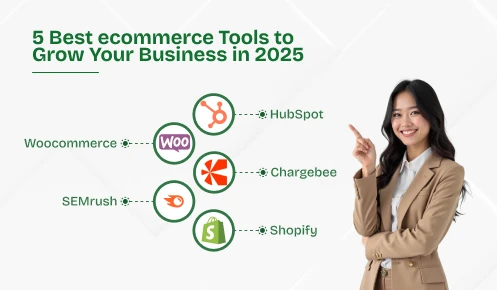
Operating an eCommerce business at present is not a matter of selling products online only. Competition is intense, expectations have never been as high for the customer, and personalization based on artificial intelligence is transforming consumer shopping behavior. In order to grow in 2026, you can use more than a great product; you have to use the tools.
Whether you are creating your online store or automating your marketing campaigns, managing subscriptions and performance, eCommerce tools provide the speed and scalability to grow. The right stack will assist you in saving on costs, reaching a greater number of customers, and making greater sales.
We will divide into this guide into what eCommerce tools are, why they are important, the top 10 tools to consider, ready-to-use playbooks, a mini case study, and best practices on how to future-proof your store by 2026.
E-commerce tools are dedicated software and applications meant to assist companies to open, operate, and expand their online retail outlets. Imagine them as your online labor force, streamline repetitive work and give you data to make more intelligent choices.
These tools represent a huge range of requirements, including managing product availability and making orders, organizing marketing efforts, and customer retention. In the abundance of choices that each of them comes with, their peculiarities, different tools have the potential to radically change your e-commerce activities.
Before we get into the details, we should unravel the reason why these tools are not only useful but essential.
These can include:
The most outstanding eCommerce tools in 2026 are not only work facilitators. They do automated campaigns, predict the behaviour of the customers, and cross-channel mediums like email, SMS, and social media without any glitches.
E-commerce tools are incredibly versatile. They power all major business models: B2C (selling to consumers), B2B (selling to other businesses), C2B (consumers selling to businesses), and C2C (consumers selling to consumers). Whether you’re a budding entrepreneur or a seasoned corporation, these tools can streamline your operations.
Here’s why you can’t afford to ignore them:
Understanding the different categories of e-commerce tools helps you pinpoint exactly what your business needs. Here are the five main types:
These specific tools are your digital detectives. They help perform competitor analysis and identify lucrative niche opportunities. The goal? To refine your website experience and optimize marketing campaigns based on hard data.
Want customers to know about your services? Attract traffic? Convert leads into sales? Marketing tools are your champions. They help businesses build their brand presence and engage effectively with their target audience.
These are the essential elements for developing and running your online marketplace. Hostinger, for instance, illustrates how integrated artificial intelligence in website development tools can streamline the user experience in creating an effective online presence in a new and innovative manner.
Analytics tools are your source of truth. They identify the issues in your sales funnel and provide real proof of your campaign’s effectiveness. Connecting to accounting software allows for validated data accuracy. With the right analytics, you can see the areas to improve on sales and marketing, predict customer demand, and make informed decisions about optimizing campaigns.
These improve the overall operations of your e-commerce by managing operations, finances, and logistics. Business solutions enhance operations, finance, and logistics. In terms of customer service, the provision of a virtual phone number is crucial in ensuring smooth customer support without requiring an employee to be physically present in an office.
In eCommerce, the victors are speed and automation. Using technologies such as VoIP solutions, companies can simplify remote customer service, and Shopify eliminates cart abandonment and accelerates checkout.
Shoppers have come to expect a quick checkout process and a uniform experience across the platform. Tools like Shopify help reduce cart abandonment and speed up the checkout phase.
Instead of manually sending the emails or SMS, platforms like HubSpot and Semrush automate advertising and configure drip campaigns.
Customers desire transparency in their transactions through pricing, data use, and returns. Tools like Chargebee that can protect you and your business while still providing GDPR/CCPA compliance help to create trust.
giosg allows you to use AI to deliver personalized interactions for your customers in real-time with chatbots and product recommendations. Personalized interactions lead to increased conversions.
Analytics tools identify customer drop-off points, campaign performance, and customer value, allowing you to enhance your growth playbook.
Emma operates a sustainable skincare business. Initially, she was selling via Instagram DMs and a simple site, but did not reach growth. In 2026, she resolved to develop a decent eCommerce stack:
Emma used a trusted storefront, automated marketing, and subscription billing, which transformed a frictionless customer experience, starting with the first click to making a repeat buy.
The internet explosion has resulted in small and large business ventures flooding investments into e-commerce across the globe. The success of eCommerce platforms and tools can determine success, with 90 percent of people shopping online at least once every six months. We are going to explore the ideal choices for expanding businesses in 2020.
Shopify is one of the most popular eCommerce solutions that allows building a professional online store without any coding. It suits companies that want to have a comprehensive one-stop shop when designing their websites, processing credit and money, and accepting payments. Merchants can also use promotional strategies to increase store AOV and encourage customers to add more to their carts.
Features
Pros
Cons
Pricing
giosg is a customer-oriented company. It is one of the most successful social media + web-based interaction tools due to the integration of live chat, AI chatbots, product quizzes, and shoppable videos.
Features
Pros:
Cons:
Pricing:
Contact sales for more information (customizable based on business needs)
A subscription management solution used in ecommerce companies that deal with products that have recurrent purchases. It is easy to deal with payment gateways, automation, and reporting.
Key Features
Pricing
Pros
Cons
CCV Shop is a one-stop ecommerce solution especially meant to serve retail shops. It provides web construction, order processing, inventory, and payment gateways.
Key Features
Pros
Cons
Pricing
HubSpot is a highly robust CRM + marketing software. It is designed to support ecommerce marketers whose requirements include email campaigns, social media management, and reporting systems to attract and keep prospective clients.
Key Features:
Pros
Pricing
An online marketing giant in terms of key research, optimization, paid advertisement, analytics, and reporting services. Ideal in marketing campaigns of ecommerce, on both social media and search.
Key Features:
Pros
Cons
Pricing
A business-level ecommerce platform is used when high customization is required. Good at inventory management, customer behaviors, and analytics report management.
Key Features:
Pros
Cons
Pricing
BigCommerce enables fast-growing companies to run their operations and operate sites that are powerful in ecommerce and have integrated marketing features. It takes B2C and B2B ecommerce stores and has no charges for transactions.
Key Features:
Pros
Cons
Pricing
ShopBox is recommended for small ecommerce shops that require a POS and an online store. It makes the payment processing, inventory control, and communication with customers easier.
Key Features:
Pros
Cons
Pricing
WooCommerce is a free WordPress plugin that is among the most adaptable ecommerce applications to create websites. It converts a simple site into a comprehensive online shop that allows marketing, inventory, and payment processing.
Key Features:
ProsT
Cons
Pricing
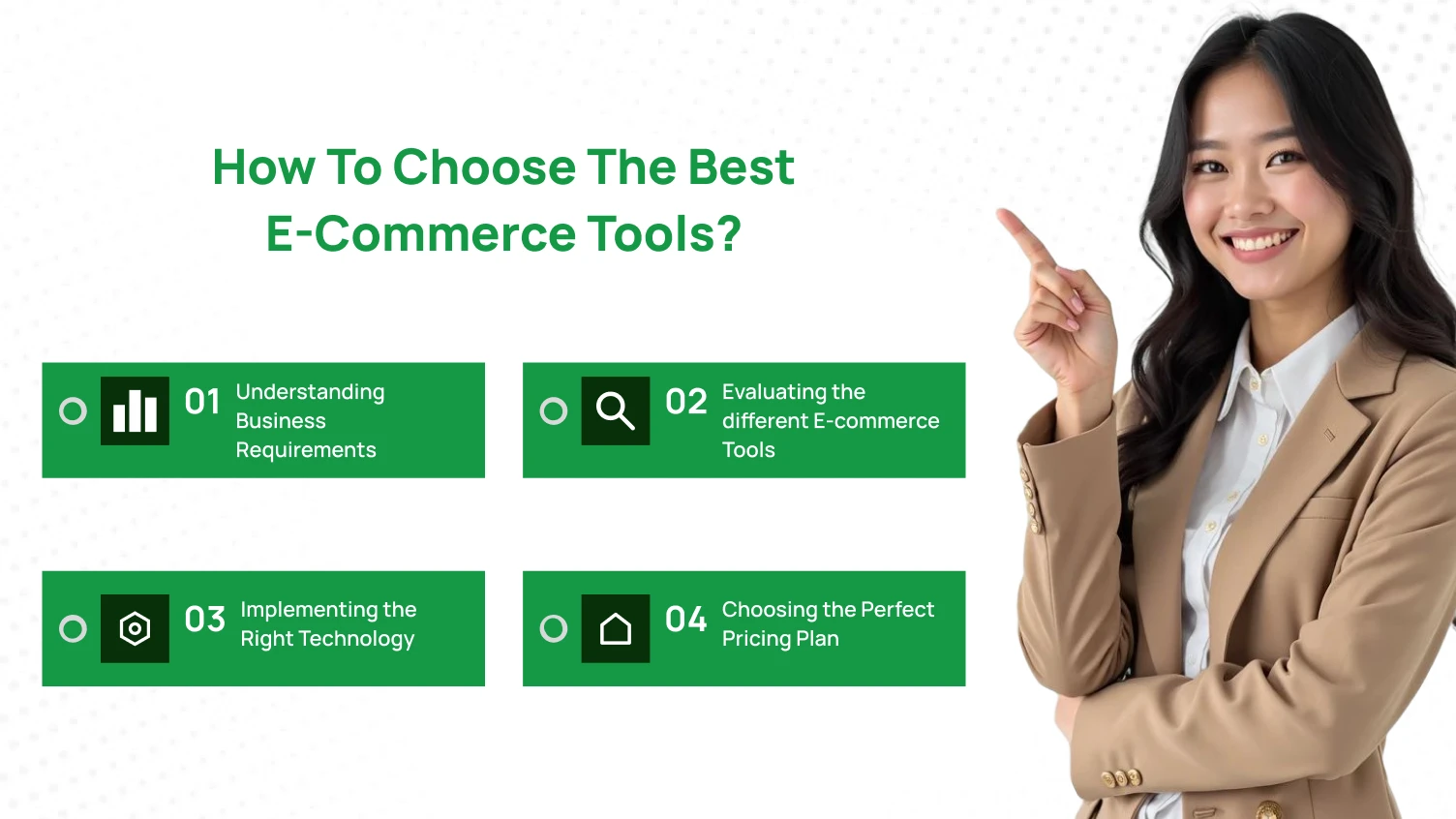
Selecting the right e-commerce tools can feel like navigating a maze. It’s easy to get overwhelmed. But with a clear, step-by-step buying guide, you can confidently choose the ideal tool for your business.
Here’s your roadmap:
Let’s be real: not every business has the same e-commerce needs. What works wonders for one might be completely useless for another. So, the absolute first step is to sit down and truly understand your specific business requirements. What are your goals? What problems are you trying to solve?
Once you’ve nailed down your requirements, it’s time to play detective. Begin comparing and researching the tools that fit your requirements. The challenges of CRM should also be taken into consideration by businesses with large databases of clients, so they can be sure to go with platforms that are compatible with their processes.
The e-commerce landscape is always evolving, with new features and benefits constantly emerging. It’s crucial to consider the technological fit. Can these new tools integrate seamlessly with your existing business systems? Compatibility is key to avoiding headaches down the line.
Finally, let’s talk money. Pricing plans for different e-commerce tools vary wildly. For startups and small businesses, finding an effective tool that fits within your budget is paramount. Don’t overspend on features you don’t need, but also don’t underspend on functionality that cripples your growth.
So, there you have it: a comprehensive look at the best e-commerce tools available for businesses of all sizes. These aren’t just fancy gadgets; they are essential keys to unlocking increased profits and deeper market penetration, especially as the global e-commerce market soars past $7.385 trillion by the end of 2026.
Our detailed list confirms that every business, regardless of its products or customer segments, can find something useful and highly profitable. Shopify often leads the pack in e-commerce tools, but strong contenders offer robust competition. For first-timers, this detailed guide simplifies the process, helping you find your ideal e-commerce match. Don’t just watch the e-commerce wave; ride it.
If you’re new to online selling, starting with user-friendly website building platforms like Shopify, WooCommerce, or Wix can save time. These tools provide templates, drag-and-drop editors, and built-in ecommerce features like product catalogs, carts, and payment gateways.
For ecommerce websites, search engine optimization (SEO) is critical. By optimizing product descriptions, improving site speed, and building backlinks, your site is more likely to rank higher on search engines like Google. This drives more organic traffic and potential buyers to your store.
Yes, there are countless success stories. Many small brands have scaled quickly by combining Shopify stores with strong social media management, targeted ads, and email campaigns. Adding tools like Zoho Inventory for stock control helps them stay consistent as sales grow.
Zoho Inventory helps sellers streamline stock management, order fulfillment, and multichannel sales. By integrating it with platforms like Shopify or Amazon, businesses can avoid overselling, maintain accurate product counts, and deliver a smooth customer experience.
Shopify Plus is designed for high-volume businesses. It offers advanced ecommerce features such as multi-store management, custom checkout experiences, higher API limits, and dedicated support. This makes it ideal for enterprises needing scalability and flexibility.
Social media management platforms not only help schedule and monitor posts but also provide analytics on engagement. By studying patterns in customer behavior, businesses can tailor content, offers, and campaigns that resonate more with their audience, boosting conversions.
