

What is a Voice Bot? A Beginner-Friendly Guide

Nobody likes being stuck on hold at a call center.
We’ve all been there, listening to elevator music and hoping to improve customer outcomes without the headache. This is where voice assistants and AI voice agents are stepping in to help.
These voice bot AIs (or bot AIs) are changing how we talk to brands on the phone and even via social media.
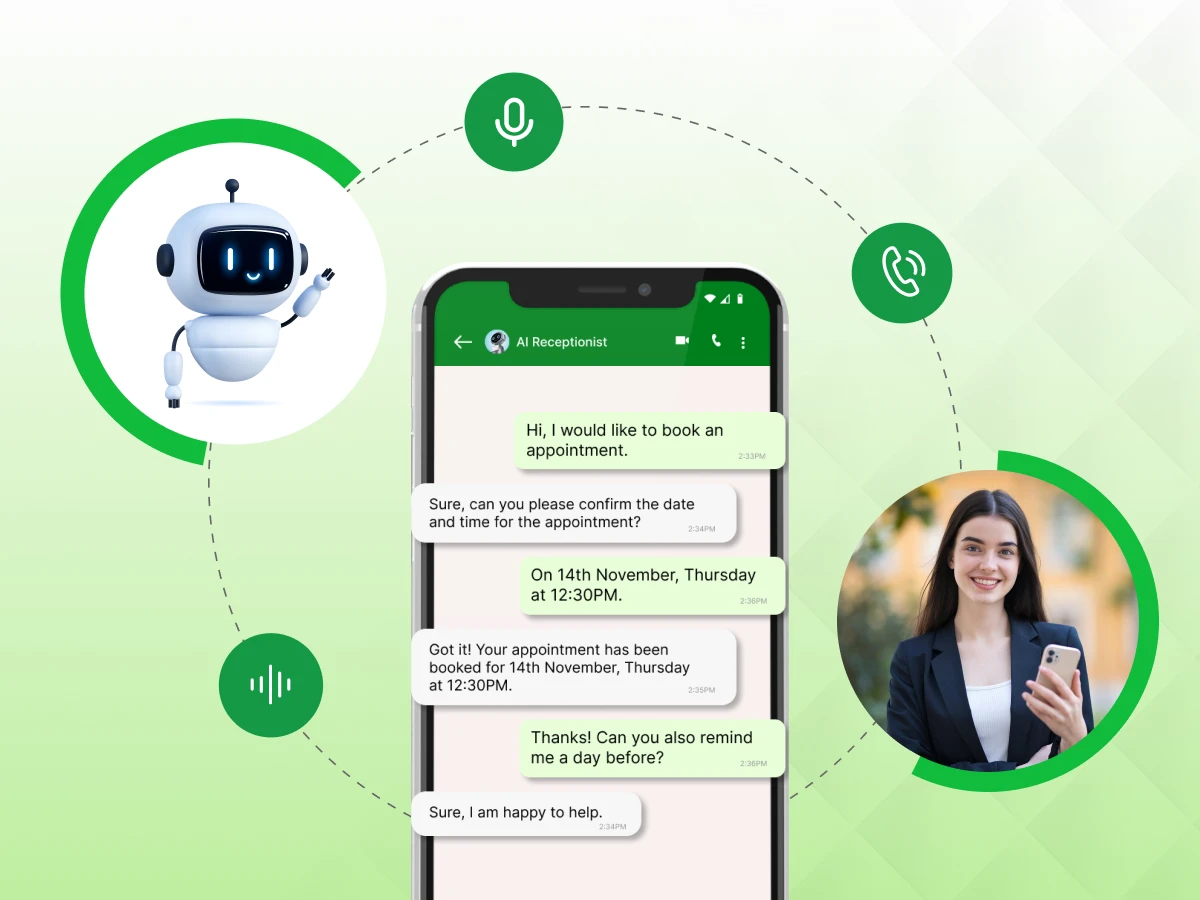
An AI voicebot takes care of customer questions, handles appointment scheduling, and offers 24/7 customer service, all of which takes the pressure off human agents.
In this guide, we’ll break down “What is a voice bot?”, how the technology works, and how it can help a business improve the customer experience.
Key Highlights:
So, what is a voice bot exactly? At its core, it’s a software tool that lets people interact using spoken language. It’s a massive step up from a traditional IVR that forces you to navigate a stiff, confusing menu.
Instead of just following a script, a voice bot actually listens to what a person says, figures out the user’s intent, and gives a helpful answer.
Example: Think about calling your bank. Instead of pressing buttons, you just say, “Can you help me with answering customer billing questions?” The AI voice bot understands you, looks up your customer data, and answers you in natural speech.
These systems bring together AI assistants, speech recognition technology, and text-to-speech (TTS). Whether they are used in contact centers, healthcare, or e-commerce, they are completely transforming customer communications.
Understanding “What is a voice bot?” is helpful, but knowing how a voice bot works behind the scenes makes its capabilities much clearer.
If you’ve ever wondered how a voice bot works, it’s basically a high-speed relay race between different parts of an AI platform.
First, the phone system or center software records your voice. The system filters out background noise so the AI agent can clearly hear the human speech, even if you have an accent or are calling from a busy street.
The bot uses automatic speech recognition (ASR) to turn your words into text. This is a vital step because natural language understanding needs text to figure out what to do next.
Once the audio is transcribed, the voice bot uses natural language processing (NLP) to look for meaning. It identifies the user’s intent and picks out key phrases so it can answer complex customer queries instead of just simple commands.
Now, the bot decides how to help. It might search a knowledge base, handle lead qualification, or, if things get too complicated, pass the call to a live agent.
The bot then puts together an answer. This allows for customized interactions based on the specific customer story or history of that caller.
Next, it’s time to talk back. Using text-to-speech (TTS), the bot turns its digital answer into natural speech. Advanced voice bot technology makes this sound very human, with the right pauses and tones.
Automate spoken messages effortlessly with AI-powered TTS, learn more about Dialaxy’s Text-to-Speech.
Finally, the bot speaks. While this is happening, the system is often performing speech analytics or audio transcription, which helps the business improve the customer experience for the next caller.
By combining speech recognition, natural language processing, and text-to-speech, voice bots provide seamless conversations.
Since voice bots often replace traditional phone menus, it’s important to see how they differ from standard IVR systems.
Voice bots and IVR systems both handle customer calls, but they offer very different experiences and capabilities.
| Feature | IVR (Interactive Voice Response) | Voice Bot |
| Interaction Type | Menu-based; users press numbers. | Natural speech: understands spoken language. |
| Flexibility | Limited; follows pre-set options. | High: can handle unexpected queries. |
| Technology Used | DTMF (keypad input). | Speech recognition, NLP, AI. |
| Customer Experience | Rigid, robotic. | Conversational, human-like. |
| Best Use Cases | Call routing, basic information. | Customer support, personalized assistance, 24/7 self-service. |
| Limitations | Cannot understand natural language; static. | Requires AI setup and training; ongoing monitoring. |
Unlike rigid IVR menus, voice bots allow natural conversation, improving customer experience and reducing frustration.
Voice bots are also commonly compared to chatbots, so let’s clarify how these two technologies relate to each other.
Businesses often confuse voice bots and chatbots, but understanding how each interacts with users is key to improving customer support.
| Feature | Chatbot | Voice Bot |
| Mode of Interaction | Text-based | Audio-based |
| Technology Used | NLP, AI, scripted flows | Speech recognition, NLP, TTS, AI |
| Communication Channel | Website chat, messaging apps | Phone systems, VoIP, call centers |
| Customer Experience | Quick text responses | Natural spoken conversation |
| Best Use Cases | FAQs, online support, chat automation | Phone support, appointment scheduling, and call volume handling |
| Overlap | Both use AI assistants, NLP, and conversational AI | Both use AI assistants, NLP, and conversational AI |
Ready to automate lead capture and streamline your sales funnel? Discover the best chatbots for lead generation on Dialaxy today.
Now that we’ve clarified the differences, it’s time to explore the different types of voice bots available today.
You’ll usually run into two different kinds of voice bot AI:
These are the “simpler” versions. They follow a strict script.
These use machine learning and generative AI to actually “think” and learn.
Rule-based bots are simple and predictable, whereas AI-powered bots offer natural, intelligent conversations.
With a clear understanding of how rule-based and AI-powered voice bots differ, let’s look at the real benefits they bring to businesses.
Using a voice bot isn’t just about having the latest AI voice bot technology; it’s about real results.
Voice bots improve service quality, cut costs, and provide 24/7 support for better customer satisfaction.
These benefits sound impressive in theory, but they become even more powerful when applied in real-world industries.
Here is how different sectors are using voice bot AI to get things done:
In the medical world, AI voice agents handle the heavy lifting of appointment scheduling and sending out medication reminders. These voice bot AIs can even triage phone calls, helping patients decide if they need a clinic visit or just some quick advice.
By answering customer (or patient) questions this way, the human agent can focus on actual care. Plus, these AI voicebots are built to keep patient records safe in a secure trust center.
Banks use voice bot technology so customers can check their balance or flag suspicious activity through a natural conversation. These AI-powered voicebots answer customer questions instantly, cutting down on waiting time.
They also help with lead qualification and customer data updates, ensuring everything stays compliant with voice bot security standards.
Online stores use AI assistants to help with order tracking and returns. Instead of a traditional IVR, customers get a conversational intelligent experience that can even suggest products based on personalized experiences.
This ensures a smooth customer experience at any hour, providing 24/7 customer service even when the main office is closed.
Telecom brands deal with massive call volumes. They use voicebots to automate tasks like troubleshooting a phone system or explaining a bill.
Using speech analytics and automatic speech recognition, these bots take the load off live agents, making sure the customer care team doesn’t get overwhelmed with repetitive customer queries.
In the housing market, a virtual assistant can book property viewings or answer specific customer questions about a listing. While the AI agent identifies the user’s intent and captures lead info, the human realtor can stay focused on closing deals.
This use of AI keeps customer happiness high because the responses are immediate.
From flight changes to hotel cancellations, voice bot use cases in travel are all about speed. These AI voicebot systems allow for customized interactions and help travelers navigate complex regulations.
By handling the self-service side of things, the staff can focus on high-level customer communications and improving the customer experience.
Across the board, these bot AIs show that businesses can cut costs and improve the customer experience with faster, more reliable phone calls.
As adoption increases across industries, one important question naturally comes up: how secure are voice bots?
When you’re looking to improve customer trust, voice bot security is usually the first thing on your mind. It’s a valid concern; handling customer data over phone calls requires a serious commitment to privacy.
The good news is that modern voice bot AI is built to meet high customer expectations for safety. By using a solid trust center approach, you can ensure that your AI voice bot is just as secure as a human agent.
To keep your customer communications safe, there are a few non-negotiables:
Even the most advanced AI can have vulnerabilities if the setup is messy. Here is what to watch out for:
If you understand “What is a voice bot?” and how it fits into your call center automation, you’ll see that it’s often safer than a traditional IVR. These AI assistants follow strict rules and don’t make the same “human errors” that can lead to data leaks.
Discover how modern call center software can transform your contact center and elevate customer experiences.
While security is critical, it’s only one part of the bigger picture. Businesses should also understand the practical limitations of voice bots.
Even though there are many benefits of voicebots, it’s important to look at the voicebot limitations before you dive in.
Sometimes speech recognition technology misses the mark because of a loud background or a thick accent. You might also find gaps in natural language understanding, where the bot doesn’t quite get a complex request.
There can also be “latency”, that awkward pause in the voice chat, which can hurt the customer experience. And occasionally, even advanced AI can “hallucinate” or give a weird answer, which is why human intervention is still so important.
A major hurdle is the lack of emotional intelligence. A chatbot or AI bot can’t feel empathy, which can be tough during a sensitive customer story. Then there is the issue of voice bot security. You have to ensure that human speech and sensitive data are encrypted.
There is also the risk of “barge-in” issues and ensuring the machine learning models aren’t biased, as that can negatively impact customer satisfaction.
Maintaining an AI-powered voice bot isn’t a “set it and forget it” task. It requires constant updates to the knowledge base and the natural language processing (NLP) engine. Also, hooking these bots up to your existing contact centers can be a technical challenge.
While voice bots are powerful, businesses must address technical, ethical, and operational challenges to succeed.
Knowing the challenges helps set realistic expectations. The next step is understanding how businesses can successfully implement a voice bot.
If you’re wondering how a voice bot works for your specific needs, getting started usually follows a few simple steps.
Integrating voicebots with VoIP systems boosts efficiency, speeds up responses, and improves call handling.
To better understand their real-world impact, let’s look at what industry research and global statistics say about voicebot adoption.
Let’s look at the data. Industry research shows that voice bot technology has moved from being a “nice to have” to a core part of call center automation.
These numbers give us a clear look at where customer care is headed and why businesses are moving away from traditional IVR.
The global market for voice bot AI was valued at roughly $4.3 billion in 2024. Experts expect it to grow by about 20.3% every year through 2034. Why the jump? It’s driven by a massive demand for better business operations and more customized interactions.
In fact, AI-powered voice solutions held over 65% of the market share in 2024, proving that enterprises are betting big on artificial intelligence.
Customers are already on board. Research shows that nearly 50% of consumers have used voice assistants to get support. When a company uses an AI voice bot for customer support, it can slash waiting time by up to 50% and boost customer satisfaction by 30%.
Interestingly, 89% of people say they actually prefer brands that offer AI assistants, showing how much these tools improve the customer experience.
Customers are already on board. Studies show that nearly 50% of consumers have used voice assistants to get support. Using an AI voice bot for customer support can slash waiting time by up to 50% and boost customer satisfaction by 30%.
Interestingly, 89% of people say they actually prefer brands that offer AI assistants, showing how much these tools improve the customer experience.
This research highlights that the future of customer support isn’t just about the tech; it’s about meeting customer expectations for a fast, natural conversation.
Implementation is only part of the process. Real value comes from when voice bots are connected to modern VoIP systems.
Combining a phone system with voice bot technology is one of the fastest ways to improve the customer experience.
When an AI voice bot is part of your VoIP setup, it can manage phone calls, handle audio transcription, and provide immediate customer service. This takes a lot of weight off the call center while boosting customer satisfaction.
When someone calls your phone system, the AI agent catches the human speech. It uses automatic speech recognition (the speech-to-text part) to “read” the words, and then uses natural language processing (NLP) to figure out the user’s intent.
To talk back, the bot uses text-to-speech (TTS) to create natural speech. If a request is too complex, the AI assistant simply hands the call over to a human agent.
Businesses are finding plenty of ways to let voicebots automate their daily tasks:
Integrating an AI voicebot into your center software offers several wins:
If you check a modern resource library, you’ll see names like Dialaxy, Dialpad AI, Amazon Connect, and Microsoft Voice AI. These AI platform options integrate perfectly with VoIP.
They allow you to move past a traditional IVR and into conversational AI, where AI-powered voicebots allow for much more customized interactions.
Learn more about VoIP: what it is, how it works, and why it transforms business communications.
Now that we’ve explored how voice bots work in real systems, let’s look ahead at where this technology is headed.
The future of customer care is leaning heavily on gen AI and generative AI. We are seeing a shift where AI voice agents are becoming more than just tools; they are becoming conversational intelligent partners.
These voice assistants are learning to understand spoken language nuances, like sentiment and context, through advanced AI.
Whether it’s a customer story shared over a voice chat or a quick check-in via social media, AI-powered voice tech will handle multi-step problem-solving with ease.
With better voice recognition, voice biometrics, and social listening tools, businesses can offer personalized experiences that feel safe and unique.
Eventually, the line between a virtual assistant and a live agent will blur, making natural conversation the standard for all customer communications. This evolution in artificial intelligence will keep customer happiness at the center of all business operations.
The voice bot is more than just a trend; it’s a fundamental shift in customer communications. By embracing voice bot technology, businesses can meet customer expectations, reduce waiting time, and allow their human agents to focus on what really matters.
Whether you call it an AI voice bot, an AI agent, or a virtual assistant, the goal remains the same: customer happiness.
A voicebot works by using automatic voice response to hear, natural language processing to understand, and text-to-speech to talk.
No, using a voice bot is perfectly legal for customer service and business operations. However, companies must follow privacy laws like GDPR or the TCPA. This involves protecting customer data, being transparent about using AI, and ensuring the AI bot respects “do not call” registries.
A well-known consumer example is a virtual assistant like Siri or Alexa. In a call center setting, an AI voice bot might handle appointment scheduling for a doctor or help with answering customer questions about a bank using natural conversation.
Yes, voice bot technology is safe as long as the provider prioritizes voice bot security. Modern AI-powered voicebots use encryption, secure APIs, and voice biometrics to protect human speech and sensitive details.
