

Inbound Call Center: What It Is, Benefits & How It Works


Valid Date: Nov 20 - Dec 04, 2026
Struggling with rising support tickets and impatient customers? You’re not alone.
Inbound call centers have become mission-critical in 2025. According to Sprinklr, 76% of people feel frustrated when companies don’t offer personal service. Also, 71% expect brands to respect their time.
These centers handle customer-initiated calls, resolve issues quickly, and improve satisfaction across industries. This guide explores inbound call centers from setup to performance, helping businesses build trust, boost retention, and stay competitive.

An inbound call center is a team or business operation that handles incoming phone calls from customers and prospects. People typically call to ask questions, resolve service issues, get technical support, check orders, or inquire about products. Agents use call center software, IVR, and call routing tools to direct callers to the right person and resolve their requests.
| Inbound call center | Inbound contact center |
|---|---|
| Primarily handles incoming phone calls. | Handles calls and other communication channels. |
| Uses phone systems, IVR, ACD, and call routing. | May use voice, email, chat, SMS, and social media tools. |
| Focuses on voice-based customer interactions. | Manages customer interactions across multiple channels. |
An inbound call center receives customer calls, identifies the reason for each call, routes callers to the appropriate agent, and records the interaction for follow-up and performance tracking.
Here’s how an inbound call is handled:
The customer dials the company’s business phone number to request assistance, information, or support.
An interactive voice response system plays a greeting and may offer menu options to identify the caller’s needs.
ACD and call routing rules direct the call to the appropriate department, queue, or available agent.
The agent speaks with the customer, accesses relevant information, and works toward resolving the issue.
Call details and outcomes are logged. When enabled, call recordings support quality assurance and training.
Managers review metrics such as FCR, AHT, and CSAT to identify service issues and improve future interactions.
An inbound call center acts as the front door of a company’s communication. It handles incoming customer requests and supports each stage of the customer journey. These operations focus on delivering helpful, fast, and personalized support. Let’s see how an inbound call center actually works:
Agents handle billing, product details, and account issues using CRM tools for faster, accurate responses. These interactions impact customer satisfaction and long-term engagement. Trained teams turn basic queries into trust-building moments that increase customer lifetime value.
Support teams resolve issues like password resets and product errors in real time. First Call Resolution is the priority to reduce repeat contacts and agent workload. Using proper routing, knowledge bases, and journey mapping avoids burnout.
Agents process purchases, answer shipping questions, and handle refunds with speed and clarity. They also drive inbound sales through helpful upselling and smooth transactions. Efficient service supported by CRM and strong phone systems boosts repeat purchase rates.
Agents listen, respond quickly, and resolve issues with empathy to rebuild customer trust. Real-time solutions like credits or apologies improve CSAT and reduce wait times. Empowered teams turn complaints into recovery wins that strengthen brand reputation.
Setting up your first inbound call center can feel overwhelming, but it doesn’t have to be. Over the past decade, this exact 7-step framework has helped launch many operations. It started with just a 3-agent startup desk. It has also scaled to a 50-seat support hub for a public company.
Step 1: Define Your Goals and Key Metrics
Set clear call center goals aligned with your business objectives. Choose one core metric like CSAT, with supporting KPIs like AHT and FCR. Use these benchmarks to guide staffing and system decisions.
Step 2: Map the Customer Journey
Visualize the full customer path from first contact to resolution. Identify friction points using past tickets or CRM insights. Build journey maps for top use cases to guide experience design.
Step 3: Choose the Right Technology Stack
Select software that supports core workflows like VoIP, ACD, and CRM. Test trial versions and assess usability, not just features. Your tech stack must enable speed, accuracy, and visibility.
Step 4: Build the Right Team
Hire agents with strong communication and problem-solving skills. Use mock calls and scorecards to evaluate under pressure. Skilled agents are critical to satisfaction and brand trust.
Step 5: Develop Your Training Program
Design onboarding and continuous learning based on real call examples. Pair new agents with mentors for confidence and consistency. Keep knowledge bases current for fast, accurate responses.
Step 6: Set Up Your QA and Reporting Framework
Track quality across accuracy, empathy, and adherence to process. Use scorecards and regular reviews to guide. QA ensures accountability and supports long-term excellence.
Step 7: Launch Soft, Then Scale
Start small to test systems, agent readiness, and workflows. Use early data to fix issues and improve performance. Scale only after validating assumptions and customer feedback.
The right call center software doesn’t just improve efficiency. It transforms how your team delivers customer experience. This feature list reflects what top-performing inbound call centers rely on every day. It helps them meet rising customer expectations and performance goals.
ACD routes incoming calls to the right agent based on preset rules. This minimizes delays and improves customer satisfaction. Route calls by skill level, not just availability. This boosts First Call Resolution and reduces unnecessary escalations.
IVR enables customers to handle routine tasks independently, allowing agents to focus on more valuable conversations. Keep menu options to three or four, and always include a “press 0” option to reach a live agent.
CRM integration lets agents instantly see the caller’s profile. This includes their past issues, preferences, and transactions. When teams can access CRM data, they cut Average Handle Time by up to 20% by skipping repeat questions.
This feature lets supervisors listen to calls and guide agents without the customer noticing. Use whisper coaching during training. It’s the quickest way to boost agent confidence during real conversations
Skill-based routing directs calls to agents based on their expertise. This improves accuracy and resolution times. Tag agents with their soft skills and language abilities. These traits significantly boost customer loyalty.
Dashboards show live data for key metrics like Average Handle Time, wait time, and agent availability. Place the dashboard on team screens to encourage transparency and healthy competition. This also promotes self-driven improvement.
Call recording helps maintain quality standards and provides coaching material. Use real call samples in training to show what effective interactions sound like. Also, highlight examples of ineffective calls to help agents learn what to avoid.
Omnichannel tools help agents handle voice, chat, email, and social media from one interface. This ensures smooth experiences across all platforms. Unified inboxes preserve context between channels and stop customers from repeating themselves.
This tool offers live tips, helpful links, and quick replies during calls. Use it during busy hours to help agents work faster without losing quality.
This collects feedback immediately after the call. It helps track Customer Satisfaction and identify training gaps. Keep surveys short with two questions. Set alerts when CSAT scores drop below the target
A call center is the front line of customer interaction. Different business goals shape its structure. The three main types are inbound call centers, outbound call centers, and blended call centers. Understanding their strengths and roles helps businesses choose the right contact center solutions.
| Feature | Inbound Call Center | Outbound Call Center | Blended Call Center |
|---|---|---|---|
| Goal | Resolve incoming customer issues | Reach out for sales, surveys, or campaigns | Balance service and outreach for efficiency |
| Call Direction | Customer → Company | Company → Customer | Both directions |
| Common Activities | Support, billing, inquiries | Sales, lead gen, research | Mix of support and sales |
| Key Technology | ACD, IVR, CRM integrations | Predictive dialers, CRM tools | Unified ACD + Dialer + CRM platform |
| Agent Skillset Needed | Empathy, problem-solving, and patience | Persuasion, resilience, clarity | Versatility, multitasking, and cross-functional skills |
Which type of call center should your business choose?
Inbound call centers handle all incoming customer interactions. Agents respond to requests like billing, product information, service issues, and order updates. Their main goal is to resolve issues quickly and boost customer satisfaction. They aim to do this without requiring follow-up calls.
These centers use tools like Automatic Call Distribution to route calls to the right agent. Interactive Voice Response systems guide customers through simple tasks. They also connect customers to the appropriate department. These tools help shorten wait times and reduce agent overload during peak hours.
Key metrics include First Call Resolution, Average Handle Time, and Customer Satisfaction scores. Agents must listen and remain calm under pressure and understand the product or service thoroughly. Their ability to provide fast and accurate solutions builds customer trust. This, in turn, encourages long-term loyalty.
Outbound call centers proactively reach out to prospects and existing customers. These teams handle telesales, appointment setting, fundraising, and survey campaigns. Their main objective is to generate leads, gather insights, or close sales to deliver measurable results.
Predictive dialers improve efficiency by skipping voicemails and busy signals. They connect agents only to live calls. CRM systems record every interaction, helping agents organize contacts and track results clearly. These tools help teams operate smoothly and increase their success rates.
High conversion rates, many contacts, and clear tracking drive success. Agents need persuasion, objection handling, and strong resilience. Their performance directly impacts the effectiveness of outbound campaigns
Blended call centers combine inbound and outbound operations. These teams adjust agent duties based on real-time call traffic or campaign needs. This flexible structure keeps teams productive and improves the overall customer experience.
Unified platforms integrate systems like ACD, IVR, CRM, and dialers in one interface. During high call volumes, agents focus on incoming support. When traffic slows down, they shift to outbound tasks like surveys or follow-ups. This setup optimizes time use and reduces idle periods.
Blended centers track KPIs such as FCR, AHT, conversion rates, and agent utilization. Versatile agents are crucial; they need to switch between support and sales roles with ease. Their adaptability helps businesses respond effectively while managing resources efficiently.
Each call center model supports different business needs. Inbound centers work best in service-heavy sectors like e-commerce or telecom. Outbound centers suit businesses focused on sales or market research. Blended centers are ideal for dynamic teams managing both functions and seasonal demand. The right setup, combined with well-integrated tools and skilled agents, drives long-term success. It also strengthens customer trust.
Tracking the right call center metrics is essential to delivering exceptional customer service and improving operational efficiency. These eight key performance indicators (KPIs) help you monitor agent productivity, customer satisfaction, and call quality. Giving your team the insights needed to optimize performance and drive better outcomes.
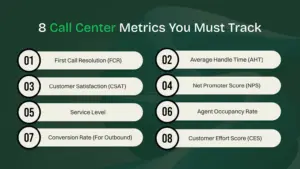
First Call Resolution (FCR) measures the percentage of customer issues resolved during the first interaction, without requiring a follow-up call or additional contact.
A higher FCR rate generally indicates that agents can address customer concerns without unnecessary transfers or repeat interactions.
Formula:
FCR = (Issues Resolved on First Contact ÷ Total Issues) × 100
Average Handle Time measures the average time an agent spends handling a customer interaction, including talk time, hold time, and after-call work.
Monitoring AHT helps managers understand how efficiently agents handle calls. However, a shorter call isn’t always better if the customer’s issue remains unresolved.
Formula:
AHT = (Total Talk Time + Total Hold Time + After-Call Work Time) ÷ Total Calls Handled
Customer Satisfaction Score measures how satisfied customers are with the support they receive. Call centers usually collect this information through post-call surveys asking customers to rate their experience.
A higher CSAT score suggests that customers are generally satisfied with the assistance provided by agents.
Formula:
CSAT = (Number of Satisfied Responses ÷ Total Survey Responses) × 100
The business should define which survey ratings count as satisfied, such as ratings of 4 or 5 on a five-point scale.
Net Promoter Score measures how likely customers are to recommend a business to others. It is usually collected through a survey asking customers to rate their likelihood of recommending the company on a scale of 0 to 10.
Based on their responses, customers fall into three groups:
Formula:
NPS = Percentage of Promoters − Percentage of Detractors
NPS is useful for understanding overall customer loyalty, but it should not be treated as a direct measure of an individual agent’s call performance.
Service Level measures the percentage of incoming calls answered within a specified time.
For example, a call center may aim to answer 80% of eligible calls within 20 seconds. This is a common illustrative target, not a universal industry standard.
Monitoring service level helps managers understand whether staffing and call routing are meeting customer demand.
Formula:
Service Level = (Eligible Calls Answered Within Target Time ÷ Total Eligible Calls) × 100
The calculation should follow a consistent reporting policy, particularly for abandoned calls and calls excluded from the target.
Agent Occupancy Rate measures the percentage of an agent’s available working time spent handling calls and completing related after-call work.
It helps managers understand how busy agents are during their working hours.
Formula:
Occupancy Rate = (Total Handling Time ÷ Total Available Time) × 100
A consistently high occupancy rate can leave agents with little time between calls, increasing fatigue and making it harder to maintain service quality. Managers should balance agent workload with customer demand.
Conversion rate measures the percentage of callers who convert into sales, leads, or appointments.
A high conversion rate indicates successful agent participation and problem-solving.
Formula:
Conversion Rate = (Total conversions/ Total outbound calls) × 100
Monitoring call results closely helps refine strategy and boost success. Use data to improve offer timing and approach.
Customer Effort Score measures how easy or difficult it was for customers to get their issues resolved.
Call centers typically collect CES through surveys asking customers how much effort they had to put into resolving a problem.
A lower-effort experience generally indicates that customers could get the help they needed without unnecessary transfers, repeated explanations, or follow-up calls.
CES helps businesses identify processes that make customer support more complicated than necessary.
| Metric | What it measures |
|---|---|
| FCR | Issues resolved on first contact |
| AHT | Average time spent handling calls |
| CSAT | Customer satisfaction |
| NPS | Customer likelihood to recommend |
| Service Level | Calls answered within a target time |
| Occupancy Rate | Agent time spent handling interactions |
| Conversion Rate | Callers who convert into leads, sales, or appointments |
| CES | Effort required to resolve an issue |
Managing an inbound call center requires more than answering calls quickly. Businesses need trained agents, clear processes, and the right tools to handle customer requests effectively. Here are seven practices that can help improve call handling and customer service.
Train agents to listen carefully, communicate clearly, and handle different types of customer inquiries. They should know how to respond to complaints, answer product questions, and guide customers through common issues. Regular training and practice calls can help agents improve their communication and problem-solving skills.
Use call routing rules to direct customers to the right department or available agent. For example, billing inquiries should go to the billing team, while technical questions should reach support agents. This reduces unnecessary transfers and helps customers get assistance from someone who understands their issue.
Give agents access to a central knowledge base containing product information, troubleshooting steps, company policies, and answers to common questions. Keep this information updated so agents can find accurate answers without putting customers on hold or asking colleagues for help.
Review call recordings and use quality scorecards to assess how agents handle customer interactions. Look at factors such as communication, accuracy, problem resolution, and professionalism. Share feedback regularly and use coaching sessions to address areas that need improvement.
Use call queuing, estimated wait-time announcements, and callback options where available to manage incoming calls during busy periods. Monitor call volumes and adjust agent schedules based on demand. This helps reduce long waits and prevents agents from becoming overwhelmed.
Collect feedback through short post-call surveys or follow-up messages. Review customer ratings and comments to identify recurring complaints, difficult processes, and service gaps. Use these insights to improve agent training and call center workflows.
Track metrics such as First Call Resolution (FCR), Average Handle Time (AHT), Customer Satisfaction (CSAT), and Call Abandonment Rate. Review these figures regularly to understand how your team is performing. Use the results to identify problems and make practical improvements.
Inbound call centers support critical needs across many industries. They handle sensitive requests, support fast decisions, and improve the customer experience. This overview shows how they meet industry demands using tested systems and strategies.
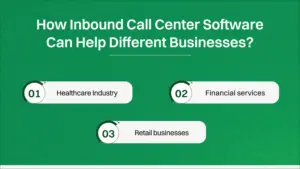
Inbound call centers in healthcare schedule appointments and manage referrals. They also handle billing questions with clarity and care. Agents follow HIPAA rules and speak calmly with patients.
They answer insurance questions clearly and help patients access services faster. This builds patient trust and reduces delays across healthcare networks.
Inbound agents in retail help with tracking, returns, and product questions. They resolve “where is my order” calls quickly. Fast service and smooth returns boost repeat shopping.
This kind of support reduces complaints and builds customer loyalty. It also helps online stores increase long-term retention.
Inbound teams in tech fix login issues and reset accounts. They guide users through feature use and onboarding. Agents answer questions about plans, upgrades, and billing.
This expert support improves satisfaction and lowers churn. It helps SaaS companies keep users happy and engaged.
An inbound call center helps businesses manage customer inquiries, provide support, and resolve issues over the phone. With trained agents, clear call-handling processes, and the right tools, businesses can manage incoming calls more effectively and deliver better customer experiences.
Dialaxy offers advanced business communication features.
An inbound call is when a customer contacts a business for help, support, or information.
Inbound services include support, inquiries, order tracking, returns, and inbound sales.
An inbound call center handles customer queries. Its goal is to resolve issues quickly and efficiently.
Use call center software with IVR and CRM tools. Smart routing helps manage and resolve calls more effectively.
Inbound calls can increase customer wait times. They also strain agents and lower efficiency without the right tools.
